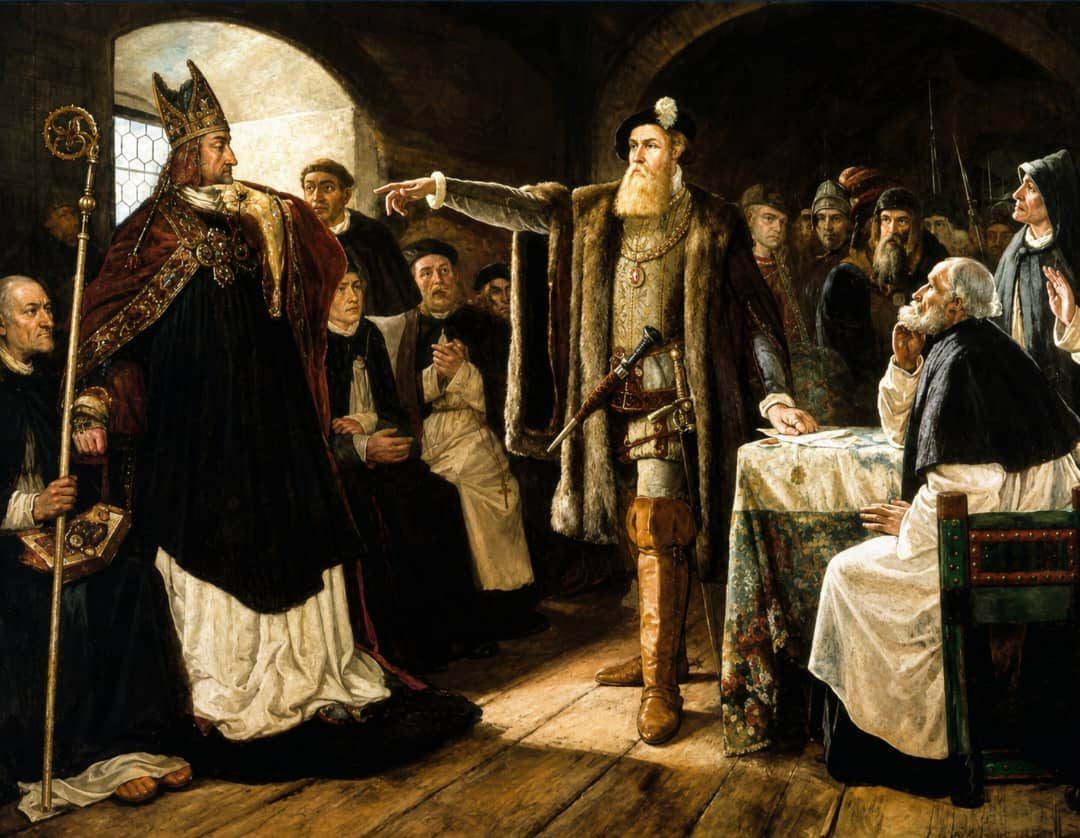
Archbishop Petri Defends the Faith to the King
Lauerntius Petri Nercius was 32 years old when he was Elected, Consecrated and Appointed as Archbishop.
He was a Professor and well known Scholar, but had never held a pastorate.
He studied with his brother Deacon Olavus Petri under Doctor Martin Luther at Wittenberg.
It was during the time spent there the future Archbishop honed his Theological acumen.
The Archbishop proved to be quite prolific when it came to Church reform.
Although he had a high regard for Luther’s teaching, the Archbishop was his own man.
He related to King Gustav Vasa on many occasions of his desire to
“hold fast to that which is good and lay aside that which was not.”
On several occasions the King threatened life of the Archbishop
with imprisonment and death, but this did not deter him.
In order to break the authority of Bishops in the Swedish Church,
King Vasa desired to discontinue the Historic Episcopate.
The Archbishop’s resistance to this and other matters fueled the King’s anger.
Undaunted the Archbishop understood the importance of
looking back over the sixteen centuries in a return to the Apostolic Church.
He was keenly aware that theological and historical polarization needed to be avoided.
He understood the Fathers and Doctors of the Church who followed in
the footsteps of the Apostles needed consideration and a full hearing.
The Ecumenical Councils of the Undivided Church he viewed as of optimum importance.
He often referred to the first Four in his composing Theological Apologia.
The Archbishop taught that his beloved Swedish Church was
the Orthodox Christian Church of Sweden since the ninth century when she was Evangelized.
In 1571 the Archbishop issued his final work on the Reformed Church of Sweden.
“Canon Eccleiasticus” or the “Swedish Church Ordinance”
was ratified by the Church in Council in 1572.
Archbishop Petri died less than a year later in 1573.
The Historic Episcopate of Bishops, Priests and Deacons were to be retained.
The Apostolic Succession was secured in Sweden.
The Sacraments and Rites of the Church were to be freed of superstition and erroneous practices.
The Swedish Mass was based on the ancient Liturgies of the Western Church prior to the Schism of 1054.
Reservation of the Sacrament of the Altar was allowed that the sick might be properly ministered to.
Vestments, Candles, Altar Cloth’s and Church Hangings were retained.
The Tabernacle and Sacred Communion Vessels were kept in use.
Statues and Paintings of Christ and the Saints were also retained.
The Swedish Church Calendar was refined and many Holy Days retained.
The Archbishop made clear in his Ordinace;
“the purity of Word and Sacrament must never be compromised.”