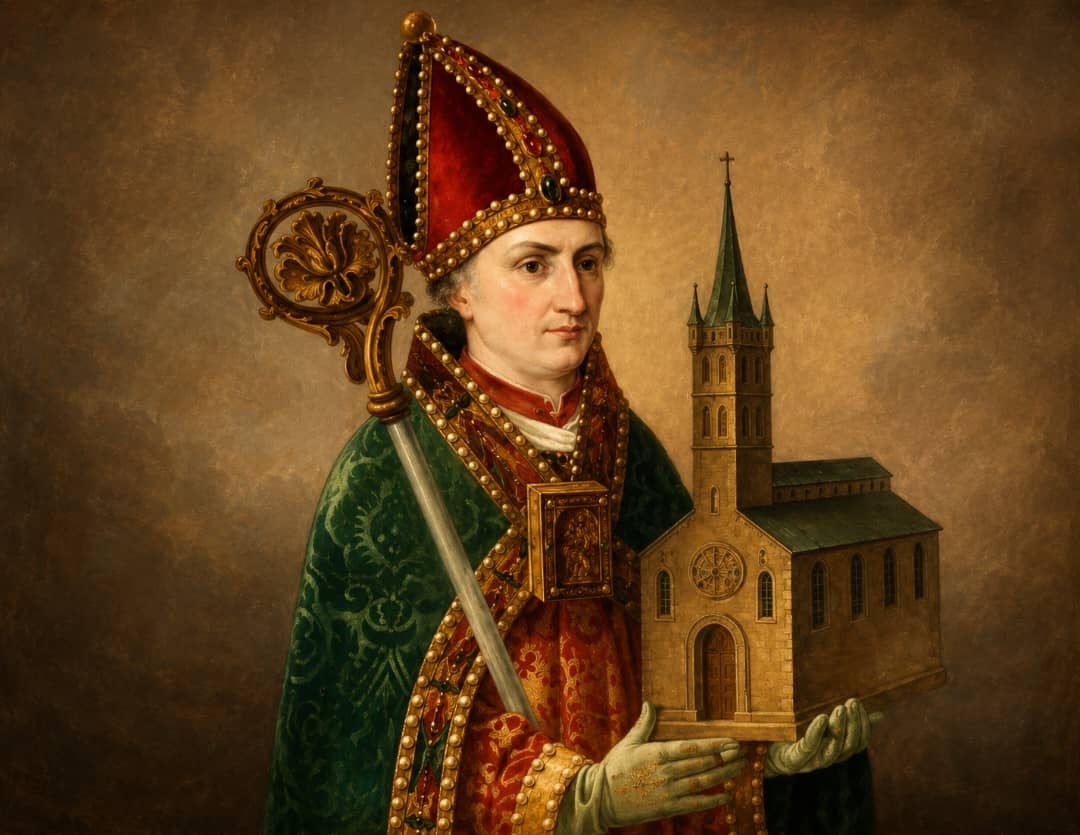
St, Ansgar the Apostle of Nordic Nations
The establishment of the Christian Church in Sweden was a long and arduous process.
The Church was planted by the efforts of Anglo Saxon and Frankish Missionary Monks in the ninth century.
They first arrived in Viking territories and had mixed results.
Unfortunately, it would take several centuries until the seeds of the Faith they planted to take Root and Grow.
The opposition and superstition of the Pagans time after time nearly obliterated the Cause of Christ in Sweden.
However the promise of Christ “the gates of Hell would not prevail against the Church”
urged holy and dedicated Missionaries forward.
The centuries wore on and the Promise of the Lord Jesus Christ and
the eventual Victory shined brighter than the sun over the Swedish Church.
St. Ansgar a Frankish Monk arrived in the trading center of Birka in 829 a.d.
He built a small Church on Bjorko Island despite intense opposition from the Pagan tribes who inhabited the area.
St. Ansgar traveled to Denmark and finally settled in Germany where he went to his eternal reward in 865.
Unlike many of his contemporaries he escaped martyrdom at the hands of the enemies of Christ’s True Religion.
After many trials and tribulations; the hard work of dedicated Missionaries resulted in
establishing the See of Uppsala in 1164 as the Archbishopric of Sweden.
The Church in Sweden much like the Church in England did not involve a
radical break with Historic Christian Orthodox Faith and Practice.
Gustav Vasa the King of Sweden (1523 to 1560) endeavored to maintain unity in the Kingdom
as a matter of good civil order and practicality.
He understood the need for Church reform due to the machinations of the Bishop of Rome
which infiltrated the Kingdom at its most meager level.
He desired to regain much of the wealth to the Crown and its citizens that was extorted by the Papal Bishops and Priests.
The King employed Archdeacon Lauerntius Andreae who was a scholar in the Church to advise him on all Church matters.
The Archdeacon was well acquainted with the ramifications of acting with haste in reforming Church abuses.
He in turn sought out the help of Deacon Olavus Petri who had studied in Wittenberg under Doctor Martin Luther.
Ties with the Papal Church began to weaken as reforms began to be introduced by these men.
In 1527 with the approval of the Diet, the King was declared the Head of both Church and State.
The Church of Sweden reclaimed her rights as the National Church.